
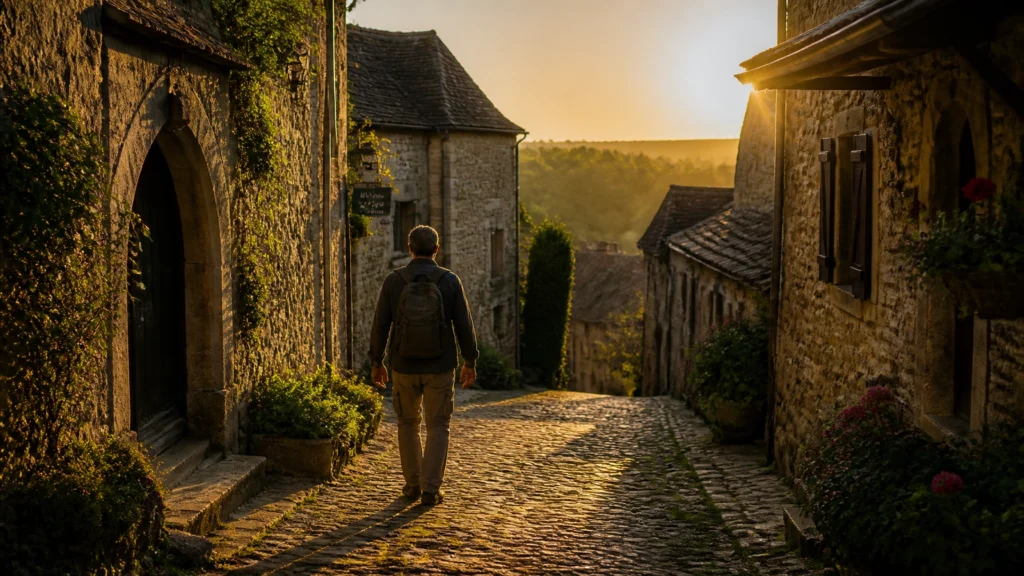
You know that feeling when the alarm goes off on a Tuesday morning? That sharp, digital chirp that pulls you out of a dream and tosses you straight into the blender of reality? The commute, the emails, the constant background hum of a life that feels like it’s running on a treadmill that someone else set to "high." We spend so much of our lives moving fast that we’ve forgotten what it feels like to just move.
But then, there’s the sound of footsteps on cobblestones.
It’s a specific sound: hollow, rhythmic, and grounded. It doesn’t sound like a deadline. It doesn’t sound like a mortgage. It sounds like history. For so many of us who are feeling the weight of the "9 to 5 grind," there is a growing pull toward the quiet corners of Europe. Not the neon-lit tourist hubs or the crowded queues of the major capitals, but the small, sun-drenched villages where time doesn't just slow down: it practically stands still.
The Magic of the "In-Between" Places
When we think of Europe, our minds often jump to the Eiffel Tower or the Colosseum. And while those are breathtaking, they often come with a side of stress: the noise, the hustle, the feeling that you’re just another number in a sea of selfie sticks. But the real heartbeat of the continent? It’s found in the "in-between" places.
Take Eguisheim in the Alsace region of France. It’s a village designed in concentric circles, where the streets wrap around each other like a warm embrace. Walking through it feels like stepping into a storybook you read as a child. The half-timbered houses are painted in shades of buttercream, sage, and dusty rose, with window boxes overflowing with geraniums that seem to glow in the morning light. There are no sirens here. Just the scent of fresh baguettes drifting from a doorway and the muffled sound of a local shopkeeper sweeping their stoop.

In places like Assisi, Italy, perched high on a hill in Umbria, the air itself feels different. It’s thinner, clearer, and carries the scent of wild rosemary and ancient stone. When you sit on a terrace overlooking the valley as the sun begins to dip, the world turns a soft, hazy gold. You aren't rushing to a museum before it closes. You’re just… sitting. You’re watching the light change on the olive groves below. You’re finally breathing deep enough to feel it in your bones.
This is what slow travel is all about. It’s the realization that you don’t need to see everything to feel everything. In fact, the less you "do," the more you experience.
The Art of Living Locally
Choosing a small town over a big city changes the way you interact with the world. In a major hub, you’re a tourist. In a village, you’re a guest.
The beauty of small-town Europe in 2026 is that it’s more accessible than ever, yet it still feels undiscovered. Places like Kinsale, Ireland, with its bright harbor and winding lanes, offer a warmth that you just can't find in a metropolis. You might walk into a pub for a quick bite and end up staying for three hours because the person at the next table started telling you about the history of the local lighthouse.
Practical travel doesn't have to be complicated. In fact, the most authentic experiences often come from the simplest plans:
- Ditch the Rental Car (Where You Can): Europe’s train network is a dream for the soul-weary traveler. There is something deeply meditative about watching the countryside roll by from a train window. It’s a chance to unplug, put your phone away, and let your mind wander as you pass through vineyards, mountains, and sleepy hamlets.
- Stay in a Guesthouse: Instead of a big hotel chain, look for family-run B&Bs. Not only is this a great way to plan a stress-free itinerary, but your hosts will often be your best source for finding those "secret" spots that aren't on any map.
- Learn the Rituals: Every small town has a rhythm. In Italy, it might be the evening passeggiata (the communal stroll through the square). In Belgium, it’s lingering over a coffee by the canal in Ghent. When you follow the local rhythm, you stop feeling like a visitor and start feeling like you belong.

If you're worried about the cost of these picturesque escapes, remember that small towns are often significantly more affordable than their big-city counterparts. You can find authentic local eats for a fraction of the price of a tourist-trap meal in Paris or Rome. It’s about being a smart traveler and realizing that luxury isn't about the price tag: it’s about the quality of the moment.
Why Your Soul Needs This
We often justify our vacations by how much we can pack into them. We return home exhausted, needing a "vacation from our vacation." But small-town Europe offers a different kind of return on investment. It offers a mental reset.
When you spend a few days in a place like Rothenburg ob der Tauber in Germany, walking the medieval walls at sunrise, something happens to your nervous system. The "fight or flight" response that we carry through our daily jobs begins to dissolve. You start to notice the texture of the stone, the sound of the wind through the ivy, and the way the light hits a bowl of fruit on a cafe table.

This is the freedom we’re all actually looking for. It’s not just freedom from work; it’s freedom from the noise. It’s the chance to reconnect with yourself, or with a partner, without the distractions of a thousand "must-see" attractions. It’s realizing that traveling alone or with a loved one in a quiet setting can be the most profound therapy there is.
I remember sitting in a tiny square in Plovdiv, Bulgaria, in a district called Kapana. The name means "The Trap," because the streets are so narrow and winding you’re supposed to get lost in them. And I did. I got lost for four hours. I sat in a small cafe, watched a local artist paint a mural, and realized I hadn't checked my watch once. For the first time in years, I wasn't worried about where I needed to be next. I was exactly where I was supposed to be.
Finding Your Own Cobblestones
You don’t have to be a millionaire to experience this. You just have to be willing to step off the beaten path. Whether it's the rugged coast of Montenegro or the rolling hills of Slovenia, there is a quiet corner of Europe waiting to remind you that life is meant to be savored, not just survived.

Maybe it's time to stop dreaming about "someday" and start looking at the map for those little dots you used to skip over. Because sometimes, the smallest towns hold the biggest pieces of our peace.
Does the idea of a quiet morning in a hidden European village feel like exactly what you need right now? I’d love to help you find that perfect escape.